Café Colette, in the 11th arrondissement, really takes the holidays seriously. This is just one of two trees (the other is inside) and the windows are painted by an artist. Despite the cold, this festive terrace is very inviting.
Want to submit a photo for our weekly column, Café Photo of the Week? Click here for submission rules. If we like it, we’ll publish it with a photo credit! Submission does not guarantee publication. Accepted photos will run in the order they are received. When you submit a photo, you give Save the Paris Café non-exclusive rights to publish it, free of charge, on our website and in social media, in perpetuity.
SIGN UP FOR OUR NEWSLETTER and get the latest articles, news, and more. (Sign-up in the left-hand menu bar on desktop, or at the bottom of the page on mobile.)
Want to submit a photo for our weekly column, Café Photo of the Week? Click here for submission rules. If we like it, we’ll publish it with a photo credit! Submission does not guarantee publication. Accepted photos will run in the order they are received. When you submit a photo, you give Save the Paris Café non-exclusive rights to publish it, free of charge, on our website and in social media, in perpetuity.
SIGN UP FOR OUR NEWSLETTER and get the latest articles, news, and more. (Sign-up in the left-hand menu bar on desktop, or at the bottom of the page on mobile.)
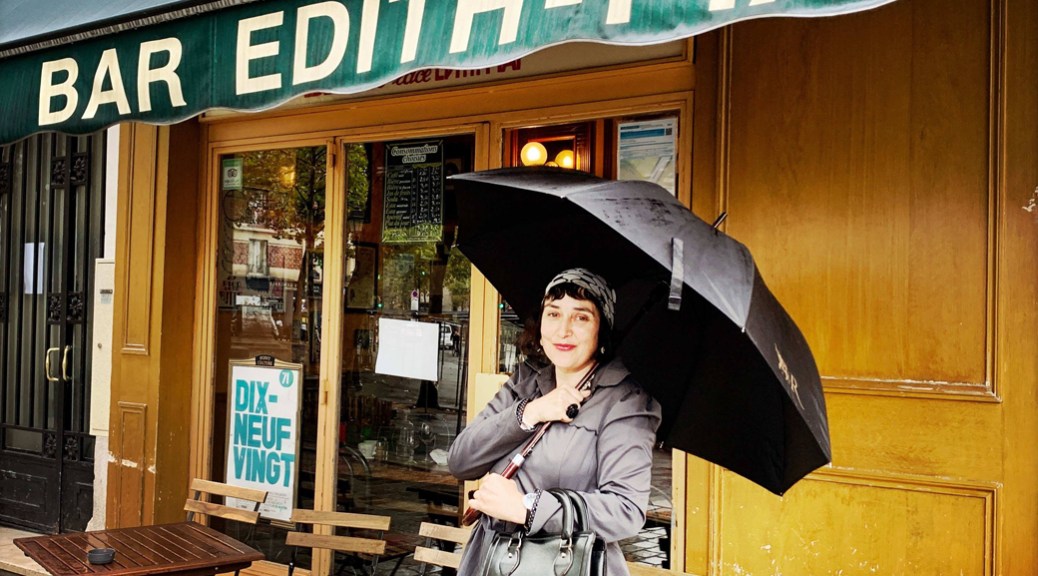
There are cafés in Paris you are attracted to just because of the name. This is why I went to Bar Edith Piaf (aka Bar de la Place Edith Piaf). I guess I don’t have to introduce you to Edith Piaf. This neighborhood place is located in Square Edith Piaf in the working class district in the 20th arrondissement where Piaf once lived. It’s also not far from the famous Père Lachaise Cemetery where she is buried.
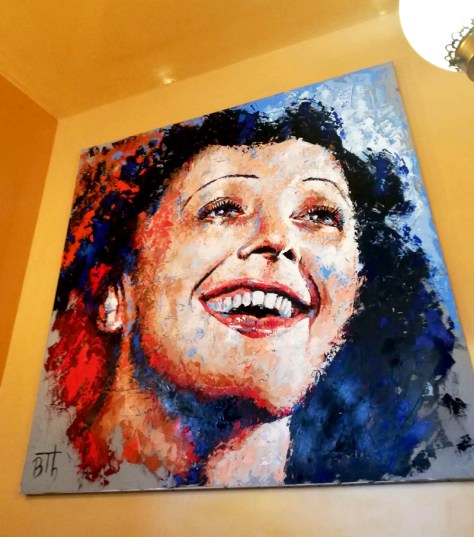
When I do my Edith Piaf tour, this place is a must to have coffee or lunch. Here, you find only locals, not one tourist. This bar, which is also a café and restaurant, is dedicated to the singer. You will feel like you’re having your coffee with Edith because she is everywhere.
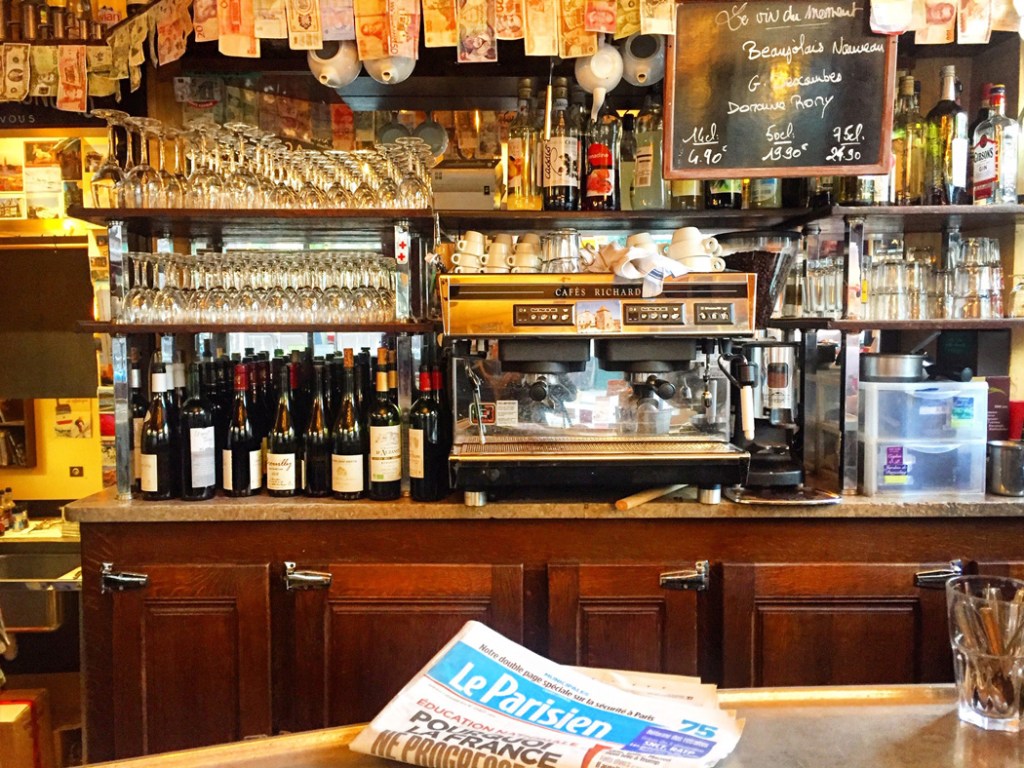
It’s not trendy or chic, and not really historical, either. It’s just an ordinary—but authentic—café with real Parisians who share their daily lives together. And a very important detail: the toilets are clean, which is always a good sign.
Since I was hungry after my coffee, I ordered duck à l’orange with roasted garlicky potatoes, for a mere 10 euros. The bread was excellent, which is another good sign. I talked to my amiable table neighbors, a young Parisian couple who were with their adorable three-week-old baby, Martin. It’s not surprising that cafés are in the Parisian DNA since they start going to them from the day they’re born, evidently. The couple chose a vegetarian lentil salad, and the Norwegian salad, with smoked salmon, both which looked very tasty.
When my friendly waiter heard my name was also Edith, he asked me if I was a singer. “Only in the shower,” was my reply.
He told me that on Saturday evenings they organize musical soirées where the customers can sing French songs. “It’s really fun,” he said. “You should come!”
I promised him I would come back, and complemented him on the delicious duck I’d had, as well as the friendly ambiance.
“You did Edith proud,” I said as I left.
Then I started singing the street as I walked away. Hold me close and hold me fast, this magic spell you cast, this is la vie en rose…
Where? Place Edith Piaf (22 rue de la Py), Paris 20ème
When? Monday-Saturday, 8am-midnight. Check for their Saturday night music soirées.
How to get there? Métro Porte de Bagnolet, line 3, exit 5
What to drink? Coffee, tea, beer, at cheap prices
What to eat? Duck à l’Orange, 10 euros; Beef Tartare, 12 euros; Vegetarian Lentil Salad, 10.50 euros; Norwegian Salad, 11.50; Croque Monsieur, 8 euros; Fries, 4.50; Chocolat Mousse, 4 euros
Don’t miss Edith’s cafe recommendations. Sign up for our newsletter on the sidebar menu on the homepage.
EDITH DE BELLEVILLE is a licensed tour guide in Paris, and the author of Belles et Rebelles, à l’ombre des Grandes Parisiennes (Éditions Erick Bonnier) available in French at Fnac.fr, Amazon.fr and Amazon.ca
Il y a des cafés à Paris qui vous attirent juste à cause de leur nom. C’est la raison pour laquelle je suis allée au bar Edith Piaf, juste à cause du nom. Je suppose qu’il est inutile que je vous présente Edith Piaf. Ce bar de quartier est situé place Edith Piaf dans un quartier ouvrier où Piaf habitait. Ce n’est pas loin du célèbre cimetière Père Lachaise où elle est enterrée.
Lorsque je fais ma visite guidée sur Edith Piaf je m’arrête obligatoirement dans cet endroit pour prendre un café ou bien déjeuner. Ici vous ne trouverez que des locaux, aucun touriste. Ce bar qui est aussi un café et un restaurant, est dédiée à la chanteuse. Vous aurez l’impression de prendre un café avec Edith parce qu’elle est partout.
Ce café n’est ni branché, ni à la mode, ni chic, ni historique. C’est un café ordinaire mais authentique avec de vrais Parisiens qui échangent à propos de leur vie parisienne de tous les jours. Et détail très important… les toilettes étaient propres ce qui est toujours bon signe.
Comme j’avais faim après mon café, j’ai commandé un canard à l’orange accompagné de pommes sautées à l’ail pour seulement 10 euros. Le pain est excellent ce qui est un autre bon signe. J’ai parlé à mes gentils voisins, un jeune couple qui était avec leur adorable nourrisson prénommé Martin âgé de trois semaines. Pas étonnant que les cafés de Paris soient dans l ‘ADN des Parisiens puisqu’ils les fréquentent à peine nés. Le gentil couple avait choisi une appétissante salade de lentilles, ainsi qu’une salade norvégienne avec du saumon fumé.
Quand j’ai dit au sympathique serveur que je m’appelais aussi Edith il m’a alors demandé si j’étais chanteuse.
– Seulement sous ma douche lui ai-je répondu.
– Les samedis soirs on organise des soirées musicales. Les clients chantent des chansons françaises, c’est très sympa, vous devriez venir.
Je lui ai promis de revenir et je lui ai dit en partant: –Mon canard était délicieux, j’ai vraiment apprécié mon repas et cet endroit est très sympathique. C’est bien, vous n’avez pas déçu Edith !
Puis je me suis mise à fredonner dans la rue : quand il me prend dans ses bras, qu’il me parle tout bas, je vois la vie en rose ….
Où ? Place Edith Piaf ( 22, rue de la Py ), 20ème
Quand ? Lundi à samedi, 8h à minuit. ( Vérifier les samedis soirs pour les soirées musicales. )
Comment y aller ? Métro Porte de Bagnolet, ligne 3, sortier 5
Que boire ? Tout est abordable
Que manger ? Canard à l’orange : 10 euros ; Tartare de boeuf : 12 euros ; Salade de lentilles végétarienne : 10,50 euros ; Salade Norvégienne : 11,50 euros ; Frites : 4,50 euros ; Croque-monsieur : 8 euros ; Mousse au chocolat : 4 euros
Guide-conférencière à Paris, EDITH DE BELLEVILLE est également l’auteure de Belles et Rebelles, à l’ombre des Grandes Parisiennes ( Éditions Erick Bonnier ) un livre disponible à la Fnac.fr, Amazon.fr et Amazon.ca
Rester au courant avec Edith et ses cafés preferés ! Abonnez-vous à notre newsletter, ici.
The bar at the popular Les Pipos, in the Latin Quarter, dates from the mid-1940s, and there has been a bistro or café on this site for the last 130 years. Woody Allen liked to hang out here when he was filming Midnight in Paris in the area.
Les Pipos was in danger of losing its lease, and its future is still unsure, but hopeful after the locals launched a petition to save it.
Want to submit a photo for our weekly column, Café Photo of the Week? Click here for submission rules. If we like it, we’ll publish it with a photo credit! Submission does not guarantee publication. Accepted photos will run in the order they are received. When you submit a photo, you give Save the Paris Café non-exclusive rights to publish it, free of charge, on our website and in social media, in perpetuity.
SIGN UP FOR OUR NEWSLETTER and get the latest articles, news, and more. (Sign-up in the left-hand menu bar on desktop, or at the bottom of the page on mobile.)
I’m sitting in my local café at lunchtime, which I use as my office. The WiFi is excellent, the manager and waitstaff are welcoming and accommodating. There are no rules, no restrictions here, no signs warning, “Laptops Forbidden.” I’m able to adapt the café to suit my life as I need, and it’s as though that’s expected. No one is imposing an agenda on me; they want me to feel at home, to call this place my own. This is the beauty of the cafés and bistros of Paris: they are an extension of our homes, and an indispensable part of our lives.
The lunch crowd has arrived. Next to me is a young couple and their baby; across, sit three woman, one in a hijab; beside them, two men huddle over a laptop discussing what looks like architectural drawings. Just outside on the terrace, a small group of construction workers of various origin are no doubt taking a break from renovating a nearby apartment, their work togs covered in plaster dust and paint.
The clientele at this café represents the makeup of the neighborhood: Jewish, Muslim, hipsters, Millennials, old-timers, and newcomers—all of us living in the same buildings together, our lives mingling on a daily basis.
Cafés are essential for local communities—inclusive public houses where everyone has a seat at the table. But Paris has lost 300 cafés since 2014.*
This is what makes the local café so special—and so essential. It’s where the entire community gathers—regardless of income, origin, religion, education, political affiliation, or skin color. “The crucible of friendship,” says restaurateur Alain Fontaine of cafés and bistros. “The melting pot where everyone meets.” Fontaine is leading an initiative to attain UNESCO status for Paris’s beloved bistros. Cafés could use this boost as well.
Cafés are the ultimate democratizer, inclusive public houses where anyone can find their place at the table. It’s something we take for granted because they’ve always been here, serving our communities. But it’s changing. Cafés are closing, both in Paris, and in France at large.
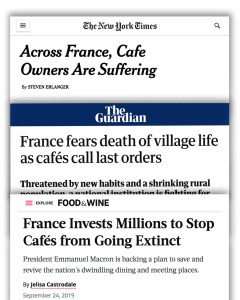
Cafe closures have been making headlines for years. The French government is finally recognizing the problem.
LOSING THE HEART OF LOCAL LIFE
Cafés in small towns across France have been the most hard-hit, mainly due to dwindling populations, not in small part precipitated by a massive reduction in national rail routes, cutting off these towns from the main artery, so they wither and die. The local businesses close—and worse, the café, often the only one in the village, leaving the residents with no common meeting place. In a country with a culture of socializing around food and drink, this loss is devastating to a community. The French government has recently understood the impact of this on the heart of the people, and is investing 150 million euros to launch an ambitious initiative that gives grants to anyone willing to open or preserve a café in a small town. It’s a start.
But in Paris, where money talks and international trends have a strong impact, cafés here are not getting the same kind of aid. The corporate chain is king, as is the foreign investor. Tech start-ups are the only small business ventures anyone wants to talk about these days. Longstanding locally owned businesses have little recourse if they’re struggling, and few resources, often shouldering the lion’s share of taxes, stymied by one-sided labor laws, and struggling to pay ever-rising rents. Cafés, too, are feeling this pressure, and in recent years, there has been a spate of closures, particularly in gentrifying or touristy areas. Paris has lost 300 cafés in just the last four years. And, like in small towns, the local Parisian café is also the center of neighborhood life, and the closure of a popular café has the same devastating impact on the residents, particularly if it’s replaced with an upscale restaurant or trendy specialty shop geared more to tourists than locals.
Cafés are also facing competition, at least in the minds of some, with the rise of the Brooklyn-style coffee house: small establishments known for artisanal beans brewed by English-speaking baristas. Often, these are owned by Aussies or Americans who’ve imported this coffee culture to Paris—at first as a response to their own dislike of Parisian café coffee, which many find bitter and wanting. But the trend has caught on in a city where all things Brooklyn are highly prized. And, if you’re a coffee-lover, these are a welcomed addition to the Paris food scene. They’re often cozy and friendly, and along with impeccable coffee, serve tasty treats like brownies, and avocado toast. If that’s your thing.
But we shouldn’t mistake these places for the new Paris café. For starters, they’re technically not cafés—they don’t keep café hours, for example—and the vibe is completely different from a classic café. The coffee house is not a place where you can stay for hours gabbing, drinking, and eating until midnight. They often have only three or four tables (some don’t allow laptops for this reason), and are more tranquil and solitary. People tend to go alone or with one other person, have their coffee and a brief pause or business chat, then move on. It’s about the coffee, not the experience.
And there’s something else decidedly different about these places: the demographic. White, young, educated, middle- to upper-class. Period. The most diverse thing about these coffee houses is that they serve vegan milk options.
SERVING (& PRESERVING) DIVERSE COMMUNITIES
Why should we care? Because these kind of upscale businesses are a sign of the changes in our communities, thanks to gentrification and rising rents. Whole neighborhoods are going upmarket, transforming in a few short years; restaurants and shops serve a new moneyed clientele. The Saint-Ambroise district in the 11th arrondissement is a perfect example of this. Suddenly, the working-class residents who have lived in these neighborhoods for decades can no longer afford to eat or shop in their own backyard, marginalized in the very quartier they call home.
I admit, as someone who blogs about Paris to an audience of a certain demographic, I have a nagging guilt about my own possible contribution to this change, real or imagined. Eight years ago, when I arrived in my sleepy neighborhood, a district somewhere between Charonne and Nation in the 11th, I was the only English-speaker around, and I liked it because I wanted to immerse myself in Paris life. I chose the area for its authentic local feel, something my New York neighborhood had long since lost. My Paris neighborhood was, and still is, home to a mix of young professionals, students, and families; the businesses are affordable and utilitarian. The cafés, if not always pretty, are welcoming and cheap. I’ve often called this area the last patch of real Paris.
Now I see signs of gentrification. The first giveaway: I hear and see English everywhere—even the servers at the cafés speak English now, menus are offered in English, perhaps catering to tourists encroaching on the district thanks to AirBnb. Prices are starting to rise. My nearby Leader Price grocery store, once frequented by the neighborhood’s working-class and elderly residents on pensions, has become an expensive organic shop with sparse, highly curated shelves. The old grocery store was packed with customers, and we all knew each other; the organic shop sits empty for now, confounding the locals who, when they do enter, wander the aisles slightly dazed then walk out with empty carts, shaking their heads. They’ve been abandoned.
The next time you see a café close, take note. Because it marks more than a change in our way of commerce; it’s a change in how we relate to each other—or more accurately, how we are beginning to not relate. Gentrification is just that: creating a place for the gentry. A certain class of people. If we build coffee houses that exclude some of us, what does this say about who we are now? It concerns me. There is a trend toward isolation that is sweeping the world, and this is affecting how we interact, vote and govern, and how we see the world. The local café is the opposite of isolation and segregation. In a fast-gentrifying city like Paris, our cafés remain a place of liberté, égalité, fraternité. A Utopia for a diverse and vital community.
It’s why, sitting in my café now, I cherish this place. Here, there is something for everyone, because everyone matters, equally. I can’t say that Paris is the most inclusive city I’ve ever lived in, or that I’ve never witnessed racism here, but for this hour or two in this wonderful place of food and drink, we are all one, united by the desire to share and connect with the world around us. We are the Paris café, and it is us.
Coffee houses are fine for some, but cafés are essential for all. This, more than any other reason, is why I fight for the survival of the Paris café. I want to be where everyone has a seat at the table. Where we all can belong.
SIGN UP FOR OUR NEWSLETTER and get the latest articles, news, and more. (Sign-up in the left-hand menu bar on desktop, or at the bottom of the page on mobile.)
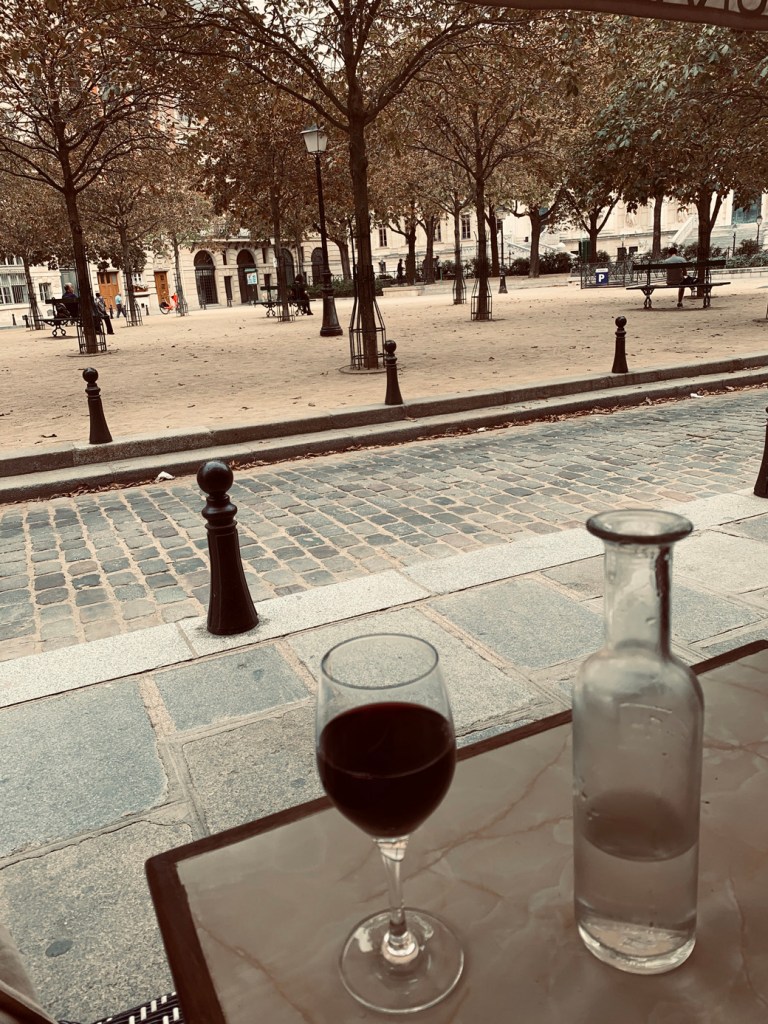
Le Caveau du Palais in Place Dauphine is a wonderful oasis of tranquility, just steps from Notre Dame, where often the only sound is the clacking from a nearby game of pétanque.
Want to submit a photo for our weekly column, Café Photo of the Week? Click here for submission rules. If we like it, we’ll publish it with a photo credit! Submission does not guarantee publication. Accepted photos will run in the order they are received. When you submit a photo, you give Save the Paris Café non-exclusive rights to publish it, free of charge, on our website and in social media, in perpetuity.
SIGN UP FOR OUR NEWSLETTER and get the latest articles, news, and more. (Sign-up in the left-hand menu bar on desktop, or at the bottom of the page on mobile.)
by Janice MacLeod, excerpted from her book, A Paris Year, page 106, “May 25: Le Bistro Chair”
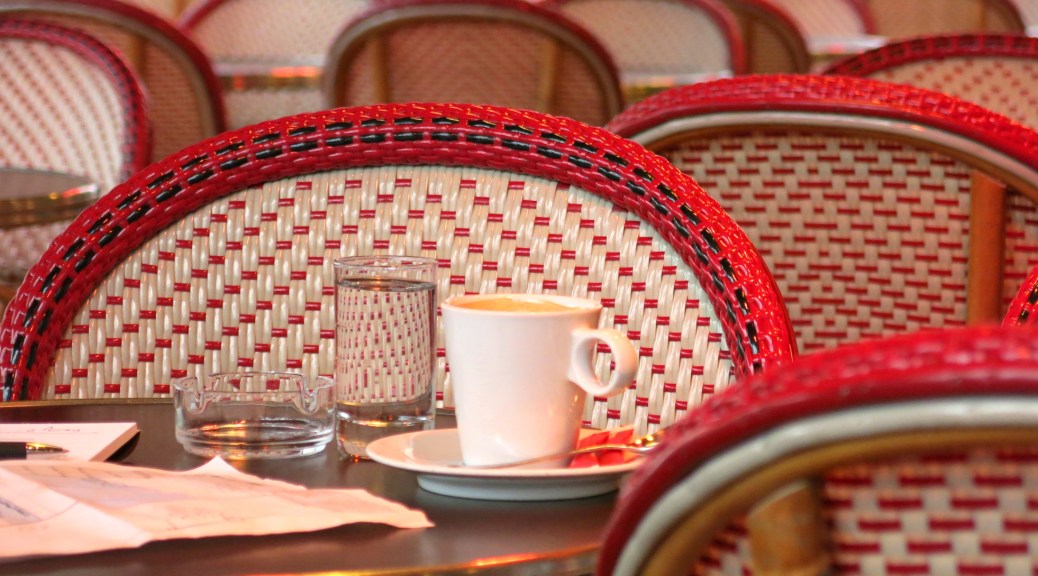
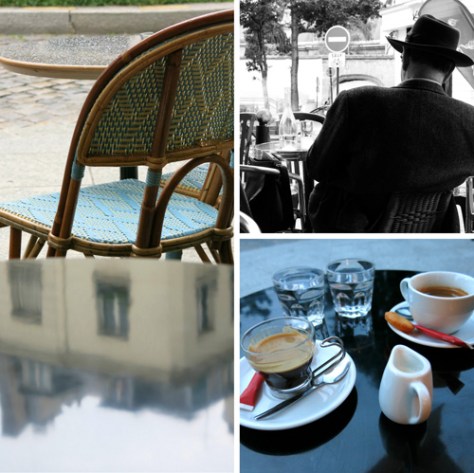
When you spend as much time in cafés as I do, you begin to notice that the typical bistro chair is like a snowflake. They are alike, yet no two are the same. Surprisingly, each chair costs on average $500.
Editor’s note: Most classic rattan bistro chairs in Paris cafés have been handcrafted by the same company since 1920, Maison Gatti. Next time you’re seated at a terrace table, look for the telltale gold name plate on the back of your chair.
JANICE MacLEOD is the illustrator and author of the New York Times best-selling book Paris Letters, and her latest book, A Paris Year, part memoir / part visual journey through the streets of Paris. Discover her world at janicemacleod.com Visit her Etsy shop Like her Facebook page
Another gem from Patty Sadauskas. Non-stop service—or service continu—on this warm and inviting terrace during a raw night, courtesy of La Tour du Temple in the 3rd.
Want to submit a photo for our weekly column, Café Photo of the Week? Click here for submission rules. If we like it, we’ll publish it with a photo credit! Submission does not guarantee publication. Accepted photos will run in the order they are received. When you submit a photo, you give Save the Paris Café non-exclusive rights to publish it, free of charge, on our website and in social media, in perpetuity.
SIGN UP FOR OUR NEWSLETTER and get the latest articles, news, and more. (Sign-up in the left-hand menu bar on desktop, or at the bottom of the page on mobile.)
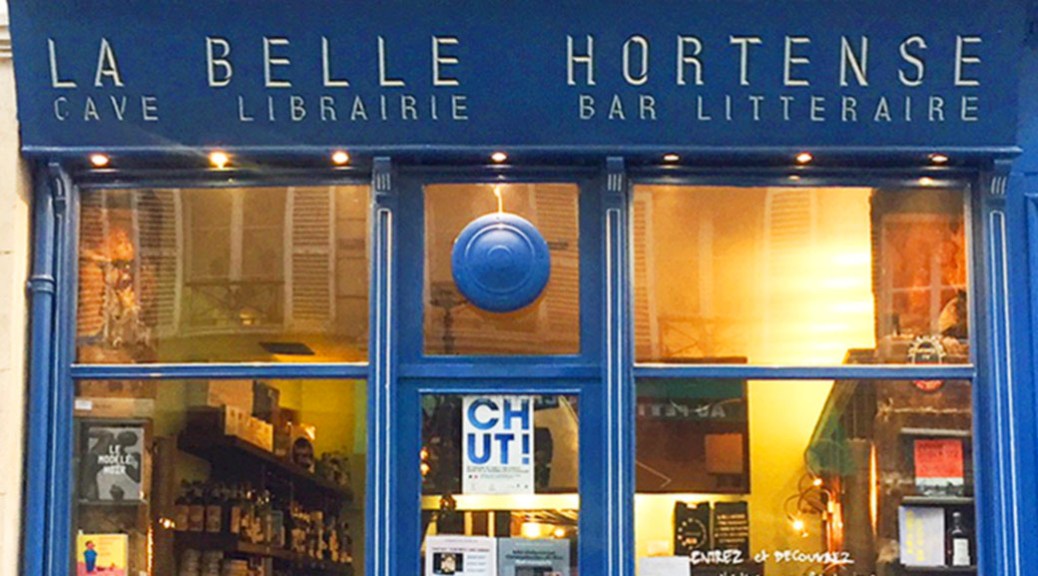
I used to organize a literary evening at La Belle Hortense with an international writers group—a mixer for new authors where we’d discuss books and drink wine. Where better to host such an event than La Belle Hortense, because it’s not just a café; it’s a book store, too.
Since 1997, this café, with its facade of electric blue, in the heart of the Marais on rue Vieille du Temple, is a literary oasis for all who pass in this trendy Paris neighborhood. On the facade is posted: Cave-Librairie-Bar Littéraire (Wine Shop-Book Shop-Literary Bar), and La Belle Hortense is all this, and more.
Every day from 17h to 2h (5pm-2am) you can stop by for a drink (there’s a good selection of French wines by the glass, or bottle), buy or browse something from their stock of beautiful novels and other books then sit, either at the bar or comfortably installed in the well-lit room at the back. The hours pass quickly in this timeless place— the sort you can only find in Paris.
From time to time, La Belle Hortense also offers readings associated with wine tastings . The wine producer and the author of the book are both present, and you can chat with these knowledgable people. What could be more Parisian? And if you’re hungry, you can visit, or order in from, one of their three other cafés across the street, all owned by restaurateur, Xavier Denamur: Les Philosophes, Au Petit Fer à Cheval, and L’Etoile Manquante. Xavier is a fascinating man, and has a few books of his own, which are also on sale at the café.
At this magical literary café you’re encouraged to consume both wine and books “without moderation,” either to stay, or to take away. But why not stay? La Belle Hortense is a beautiful combination of my two most favorite things: literature and oenology, and I highly recommend you explore it.
La Belle Hortense, 31, Rue Vieille du Temple, 4ème. Métro: Saint Paul or Pont Marie, 01.48.04.71.60
FILLY di SOMMA is a hospitality professional who lives between Rome and Paris. She grew up in her family’s hotel business in Castellammare di Stabia, in Italy, and hospitality is in her blood. She has dedicated her career to bringing people of different cultures together via tourism, and organizes cultural events such as Paris Hospitality, Discovering Japan in Paris, Social Writing, and Paris Italian culture. Filly speaks five languages including Japanese, and is also a travel journalist, contributing regularly to Where Rome, among others. Discover her blog.
SIGN UP FOR OUR NEWSLETTER and get the latest articles, news, and more. (Sign-up in the left-hand menu bar on desktop, or at the bottom of the page on mobile.)
I was trying to connect with my friend Leonard Pitt, the Berkeley-based author of Walks Through Lost Paris: A Journey Into the Heart of Historic Paris. I wanted to know Lenny’s views of Parisian café culture then—when he lived in Paris in the 1960s—and now. He was to respond from his computer at the café in Berkeley’s French Hotel (now the SenS Hotel).
Working from my computer at the dreaded Starbucks Odéon, the setup seemed a bit surreal. Conversing with Lenny via computer at an American-based French Hotel café, and me in Paris at an American-owned chain outlet (I just cannot label Starbucks a café) gave the exchange an absurd gravitas that makes me smile to this day.
Lenny is a passionate proponent of a café-centric lifestyle he posits against the Protestant work-ethic routines of a Puritanized America. He is also passionate about the almost eternal beauty of Paris and works closely with the International Coalition for the Preservation of Paris, an organization whose mission is to resist new developments that would dwarf the incomparable and relatively low Paris skyline with a ring of giant skyscrapers around the picturesque centre of Paris—the heart of Paris that gave rise to café culture in the first place, and to the flâneurs who have strolled there ever since.
Lenny emailed me that “Nothing better symbolizes the congeniality, the rhythm and sheer joie de vivre we ache to recapture in life than the café.” Well put, Pitt! But one man’s joie de vivre is another man’s (or woman’s) morning coffee ritual, writing or art studio, afternoon or evening gathering spot for conversation and nourishment, or flâneur’s solo observation post. And often, all the above and more. The traditional Parisian café is more than the sum of its parts.
When I go to a Paris café to wake up with a café crème, the least important criteria for me are the coffee’s origin, quality or even, I confess, taste. But at 7a.m. I don’t really care. My legs may get me to the café, but my critic’s brain is still on snooze. This particular summer I began most days at my café du coin (neighborhood café), Café Madame. There is nothing exceptional about Café Madame—they serve a typical petit déjeuner (passable coffee, acceptable croissant or buttered tartine, reasonably fresh orange juice)—except for its convenient proximity to my apartment and the Luxembourg Gardens nearby, a flaneur’s dreamscape.
WORKING (TRAVAILLER): READING (LIRE), WRITING (ÉCRIRE), SKETCHING (FAIRE DES CROQUIS)
Any café can be a working café, depending on one’s personal requirements. Kaaren Kitchell, an expat novelist, poet and blogger (Paris Play), combines her daily one-hour walk with her writing and editing projects, so her café must be at least a thirty-minute walk from home. Her other criteria include a quiet ambiance and, ergo, few tourists. “The French know how to modulate their voices,” says Kitchell.
On the other hand, expat author (Paris Par Hasard: From Bagels to Brioche), tour guide, and bon vivantTerrance Gelenter, prefers to work in crowded and noisy icons like Les Deux Magots and Café Montorgueil. Every Sunday from 11AM to 1PM, Gelenter holds “office hours” for his tour clients and visiting Anglophone writers, artists, filmmakers, and the like. It may not seem like work when you meet with him at his usual outdoor table, but he is definitely working the terrace.
CONVERSATION (PARLER, DISCUTER, LA CONVERSATION)
Where better than at a café to have a conversation? Dating back to its origins in the late 17th century, the Paris café has inhabited a middle world between public and private space where, unlike at more food-focused bistros and brasseries, spirited inter-table discourse is welcome, if not required. This “free speech movement” was not invented in Berkeley in 1964. For 18th-century dramatists and philosophers and 19th-century Impressionists who broke with the stifling constraints of the Academy, the café became a salon where artists could engage freely in debates over aesthetic issues–with the help, of course, of sufficient, if not addictive, amounts of coffee, wine and, more euphorically, absinthe and even opium. Talk about Happy Hour (pronounced app-ee ower), which these days begins in cafés as early as mid-afternoon.
WATCHING (OBSERVER) AND RESTING/NAPPING (SE REPOSER/FAIRE LA SIESTE)
The café, invented in 16th-century Istanbul, was destined for “… the eminently Parisian compromise between laziness and activity known as flânerie!” This drollery by Victorien Sardou, quoted in Edmund White’s book, The Flâneur: A Stroll through the Paradoxes of Paris (Writer and the City), sums up the high regard for lounging and loafing in a bygone era before commercial productivity became Western civilization’s highest value.
As for the café’s function as an urban resting place, it is a tourist’s necessity after days filled with shopping and sight-seeing. The café’s napping function is, I admit, a conceptual stretch. And although traditional café owners accept long patron visits and minimal consumption, I don’t think they would tolerate napping. Certainly not the high-end cafés, which drive off flâneurs as early as 11 a.m. under the pretext that the tables must be set for luncheon.
À CHACUN SON CAFÉ
Summing up the functions of the Parisian café, and depending on one’s needs—whether tourist, artist, working professional, student studying for exams, mother with hungry children, or first-date flirters—the café is a home away from home, an office away from the office, a study hall, a restaurant for nourishment and celebration, a bar for drinks and flirtation, or just an observation post for thinking, dreaming, and resting. Napping is optional. À chacun son café!
Get your copy of Cafe French at Shakespeare and Company (37 Rue de la Bûcherie, 5ème), and The Red Wheelbarrow Bookshop (9 Rue de Médicis, 6ème), or online, here.
L. JOHN HARRIS is an artist, food writer, publisher and filmmaker working in and around Berkeley’s Gourmet Ghetto. While attending art school at UC Berkeley Harris enlisted in the California cuisine revolution of the 1970s, clerking at the Cheese Board and waiting tables at Chez Panisse. His The Book of Garlic (1974) launched another food revolution—the garlic revolution—and his organization, Lovers of the Stinking Rose, sponsored garlic festivals all across the United States, including the legendary Gilroy Garlic Festival. In the 1980s Harris’s Aris Books published cookbooks by many of the finest Bay Area cooks and food writers, including the legendary M.F.K. Fisher. Exploring the medium of documentary film in 1990s, Harris wrote and co-produced Divine Food: One Hundred Years in the Kosher Delicatessen Trade, which was featured on PBS and at Jewish film festivals internationally. Harris’s last book, Foodoodles: From the Museum of Culinary History (2010) features over 90 of his food cartoons and a foreword by the renowned chef, Jeremiah Tower. Harris lives in Berkeley and Paris and is the curator of the Harris Guitar Collection at the San Francisco Conservatory of Music.
SIGN UP FOR OUR NEWSLETTER and get the latest articles, news, and more. (Sign-up in the left-hand menu bar on desktop, or at the bottom of the page on mobile.)
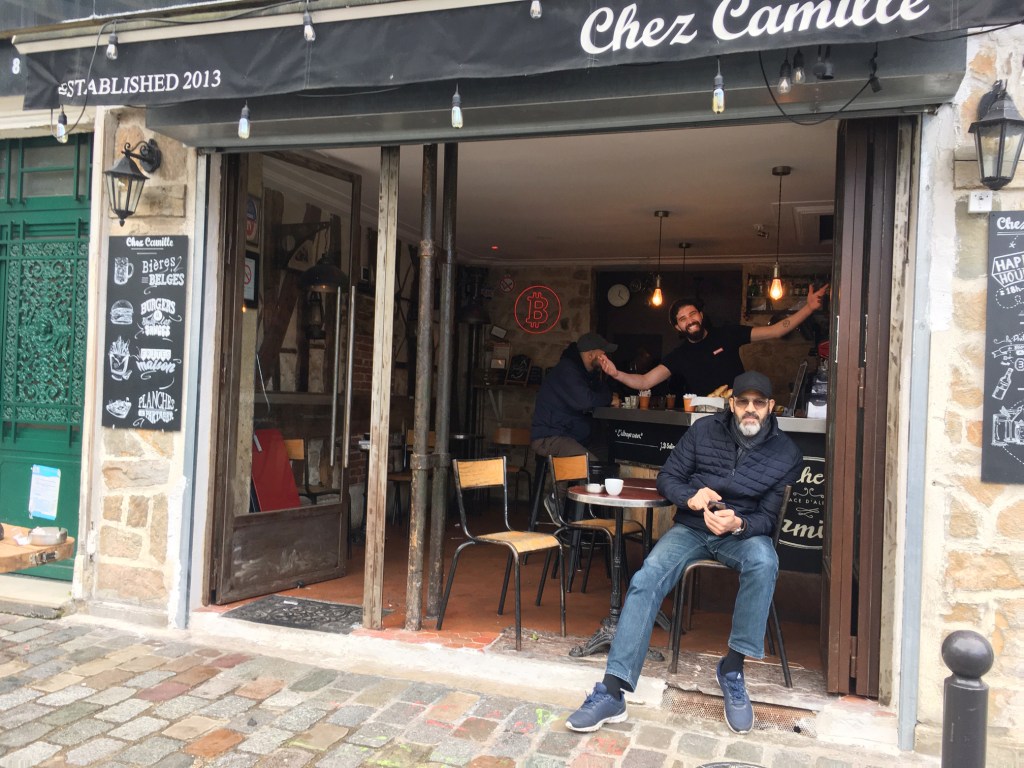
You might think his antics ruined a good shot. Just the opposite. Accidents are what make life happen. Captured at Chez Camille on Place d’Aligre, by writer Gabrielle Luthy.
This Chez Camille calls itself a “bar” on social media to distinguish itself from the other Camilles in Paris. But it serves food and keeps café hours, like any other. A favorite place of market vendors for taking a break during the hectic market day.
Want to submit a photo for our weekly column, Café Photo of the Week? Click here for submission rules. If we like it, we’ll publish it with a photo credit! Submission does not guarantee publication. Accepted photos will run in the order they are received. When you submit a photo, you give Save the Paris Café non-exclusive rights to publish it, free of charge, on our website and in social media, in perpetuity.
SIGN UP FOR OUR NEWSLETTER and get the latest articles, news, and more. (Sign-up in the left-hand menu bar on desktop, or at the bottom of the page on mobile.)
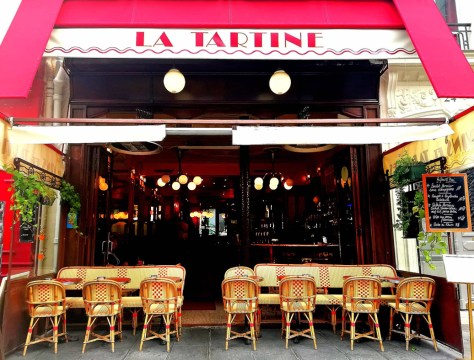
[Trouvez ci-dessous la version française] Dorothy and her suitcase are waiting for me at La Tartine. Dorothy just arrived from Seattle. Once a year she makes her pilgrimage to Paris because “Paris is my only home in the world,” she says. She didn’t have to tell me where La Tartine is, because it’s a café I’ve known forever. What is a tartine? It’s a piece of bread with a bit of butter that most French people, like me, eat for breakfast. (Don’t assume I eat croissants full of butter every morning. If I did, my clothes would not fit me anymore.)
I greet my friend with a bonjour as I arrive. “Happy to see you again!” I say. “How are you ?” I give her a kiss (faire la bise) on both cheeks.
“Bonjour, ma chérie!” Dorothy is funny; she always calls me ma chérie (my darling). “I’m very happy to be in Paris, but I’m exhausted.”
I laugh as I point out that we’re wearing the same exact outfit: a black dress with white polka dots.
“It’s my travel uniform when I come to Paris,” she says. Then she tells me to order what I want. “It’s my treat.”
It’s almost lunchtime, but Dorothy orders only a café-crème (coffee with milk). It’s two o’clock in the morning for her, so she’s not in the mood to eat, even though there are many different tartines on the menu: goat cheese, ham, duck. I’m in the mood for something exotic, so I choose the Scottish tartine with smoked salmon.
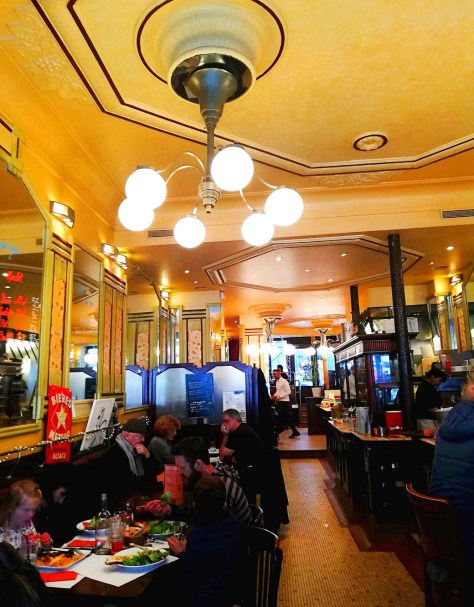
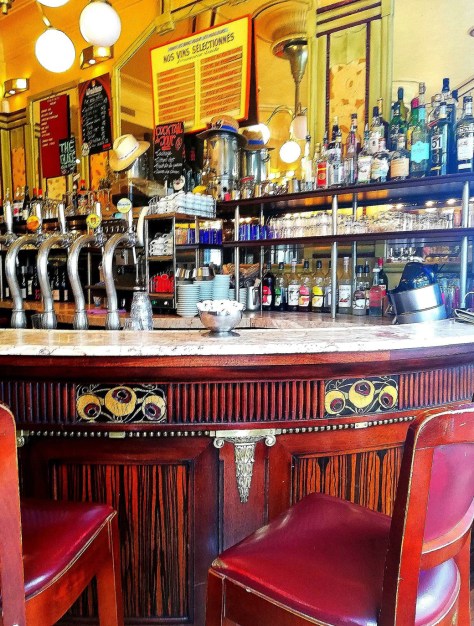
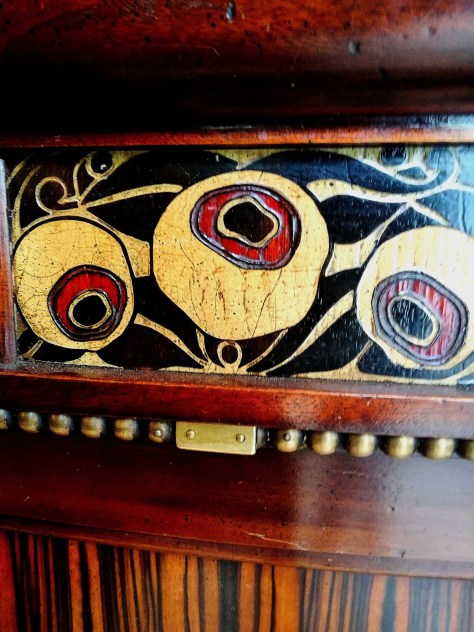
Everything in this café reminds the 1920s, from the gold, geometric Art Déco engravings on the wood bar, and on the wall to the old posters and the lamps that give off an amber glow.
Sitting next to us, an old bearded man is writing. He closes his note book and takes a sip of his beverage, something topped with sweet whipped cream, or crèmechantilly as we call it in French. It looks good. I ask what he’s drinking.
“Un chocolat viennois,” he tells me, winking.
I explain that I was tempted to order one, but decided not to because the decadent Viennese hot chocolate would not go with my Scottish salmon. The gentleman agrees, nodding his head.
Our young waiter arrives with our orders, and I ask him how long the café has been around. “I like it very much.”
“Since 1924 ,” he answers with a smile. “We’re not allowed to move anything. The bar hasn’t changed since then.”
“Incredible! 1924!” I say. “The same year as my perfume!”
I explain to Dorothy
that the law forbids altering historic landmarks, like certain old buildings,
even showcases of historic boutiques—and fortunately, vintage cafés like La
Tartine.
I ask Dorothy if we should
order dessert.
“Good idea!” She tells me to choose what I want.
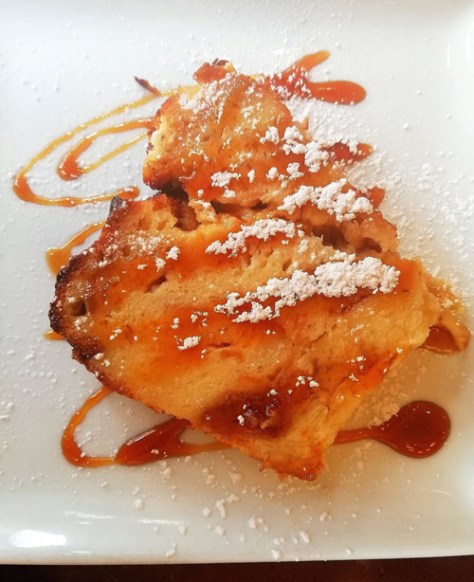
But it takes me fifteen minutes to decide so I ask the waiter to help me make up my mind. Jérôme (I asked his name) recommends the homemade French toast. I tell Dorothy that in France we call French toast “pain perdu” (lost bread), because we use day-old bread in order not to waste—or “lose”—it.
Since Dorothy has to wait to check in to her hotel, we stay a long time in this charming café. The atmosphere is perfect for staying all day: no blaring TV, no radio with awful music—nothing too modern here. Just silence like in the good old days. We swap stores about what’s new in our lives since last year.
“You know, Edith, when I’m in Paris, I am reborn,” Dorothy tells me. “I become more feminine, more myself. I like everything here: the fabulous clothes of the Parisian women, the light, the smell of the food. And I really like the old cafés like this one.” Then she adds, “And this pain perdu.”
She’s right. The pain perdu (which I ate all by myself) was delicious. I thank Jérôme for his good advice, then point out that he has the same name as Napoléon’s youngest brother: Jerôme Bonaparte. (I can’t resist a teaching moment.)
But now it’s time to go; Dorothy needs to rest. I apologize for talking too much with the waiter and the old man. “But when I’m in a café,” I say, “I like to learn about the lives of my fellow Parisians.” I thank her for inviting me to this lovely place.
“Oh you’re welcome, ma chérie!” she says. “I’m glad you chatted with the waiter. My hotel is just next door, so I know where I’ll be having my breakfast every day for the next two weeks.” She shoots me a big smile. “I’m so glad I invited you to lunch because, thanks to you, the waiter won’t treat me like a tourist. You gave me credibility here. You’re my credibility lunch date!”
I laugh, and faire la bise with Dorothy, bidding her “Au revoir.“
As I walk away, I wonder if Dorothy was onto something. Maybe this could be my new career: Credibility Lunch Date for visitors to Paris. I’m available! —Edith de Belleville
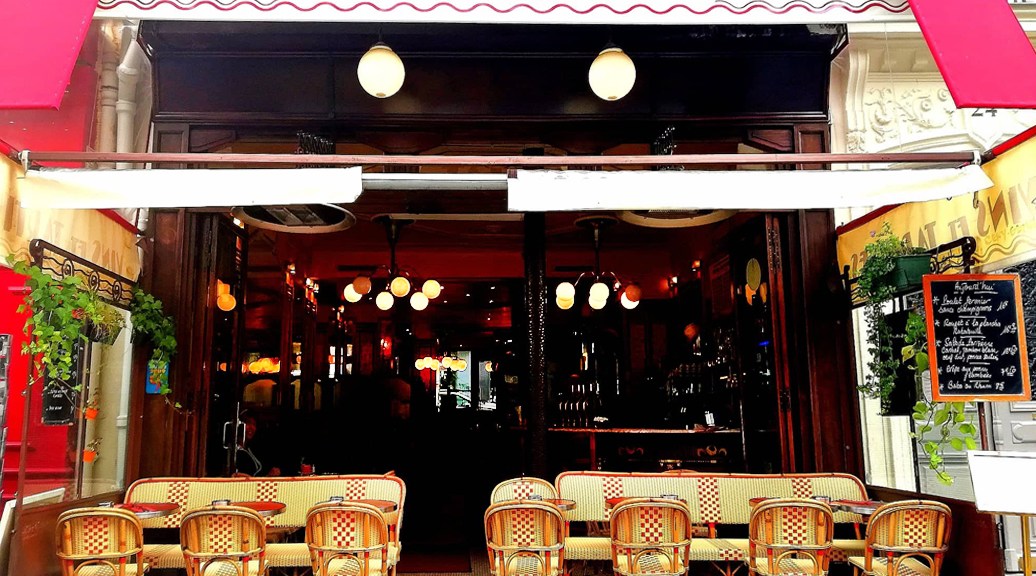
Where? 24 Rue de Rivoli, Paris 4ème
When? Monday to Saturday, 8:00am-11:30pm; Sunday : 11am – 11pm
What to drink? Happy hour 4:00-9:00pm; Beer Pils : 4 euros; Cocktails: 5 euros; Coffee (100% arabica): 2.50 euros; Café crème: 4 euros; Hot chocolate : 4 euros; Viennese coffee or Viennese hot chocolate: 5.50 euros; Tea: 4.50 euros; Fruit juice: 4.50 euros
What to eat ? A tartine with a small salad (ham, goat cheese, smoked salmon ) from 10 to 12 euros; French fries: 4 euros; Desserts: brownie, French toast, apple pie, crêpes: from 7 to 8 euros
How to go? Métro Saint Paul, line 1
Don’t miss Edith’s cafe recommendations. Sign up for our newsletter on the sidebar menu on the homepage.
EDITH DE BELLEVILLE is a licensed tour guide in Paris, and the author of Belles et Rebelles, à l’ombre des Grandes Parisiennes (Éditions Erick Bonnier) available in French at Fnac.fr, Amazon.fr and Amazon.ca
Dorothy et sa valise m’attendent à La Tartine. Dorothy vient juste d’arriver de Seattle. Une fois par an elle fait un pèlerinage à Paris car Paris est ma seule maison au monde dit-elle. Elle n’a pas eu besoin de me dire où se trouve La Tartine car c’est un café que je connais depuis toujours. Qu’est ce qu’une tartine? C’est un morceau de pain avec un peu de beurre que je mange, comme la plupart des Français, au petit-déjeuner. N’imaginez pas que je mange un croissant plein de beurre chaque matin. Si je faisais cela je ne pourrais plus rentrer dans mes vêtements.
—Bonjour Dorothy ! Je suis contente de te revoir. Comment vas-tu? Bienvenue à la maison! lui dis- je tout en l’embrassant chaleureusement sur les deux joues pour lui faire la bise.
—Bonjour ma chérie ! Dorothy est drôle, elle m’appelle tout le temps ma chérie. Je vais bien, très heureuse d’être à Paris mais je suis épuisée.
—Regarde nous sommes habillées pareil ! lui dis-je en riant. Elle et moi portons la même robe noire à pois blancs.
—C’est ma robe parisienne quand je voyage à Paris. Prends ce que tu veux c’est moi qui invite.
C’est presque l’heure du déjeuner mais Dorothy ne prend qu’un café-crème. Il est 2 heures du matin pour elle et elle n’est pas d’humeur à manger. Il y a plusieurs tartines différentes sur le menu: Avec du fromage de chèvre, avec du jambon ou avec du canard. Comme je suis d’humeur exotique je choisis la tartine écossaise avec du saumon fumé écossais. Tout dans ce café rappelle les années 20 : Les gravures dorées géométriques Art déco sur la bar en bois et sur le mur, les anciennes affiches et les lampes qui diffusent une lumière couleur d’ambre. Près de nous est assis un vieil homme avec une barbe qui écrit. Il ferme son cahier puis déguste sa boisson qui déborde de crème chantilly. Ça a l’air bon. Je lui demande ce qu’il boit:
—Un chocolat viennois me répond-il avec un clin d’oeil.
Je lui explique que j’hésite à en prendre un.
Finalement je lui dis que j’ai changé d’avis. Le chocolat chaud décadent
autrichien se marie mal avec le saumon écossais. Le vieux monsieur m’approuve
en faisant oui de la tête.
—J’aime beaucoup ce café, depuis quand existe t-il? je demande au jeune serveur qui nous apporte nos commandes.
—1924 me répond-il avec un sourire. Nous n’avons pas l’autorisation de bouger quoique ce soit ici. Le bar n’a pas changé vous savez.
—Incroyable! 1924! La même année que mon parfum!
J’explique à Dorothy que la loi interdit de détruire le patrimoine parisien comme certains immeubles anciens, les devantures des vieilles boutiques et heureusement pour nous, les cafés vintage comme La Tartine.
—On partage un dessert Dorothy? —Bonne idée! Choisis ce que tu veux.
Je prends quinze
minutes pour décider ce que je veux. Je demande au gentil serveur de m’aider à
faire mon choix. Jérôme (je lui ai demandé son prénom) me conseille de prendre
le pain perdu maison. Je dis à Dorothy qu’en anglais on appelle cela le toast français mais qu’en France on
l’appelle le pain perdu car on
utilise le pain de la veille pour ne pas le perdre.
Dorothy doit
attendre que sa chambre soit prête alors nous restons un long moment dans ce charmant
café. L’ambiance est parfaite pour rester toute la journée: pas de télé, pas de radio avec une musique
horrible, rien de trop moderne ici, juste le silence comme au bon vieux temps.
Nous échangeons des confidences sur ce qui est arrivé de nouveau dans nos vies
depuis un an.
—Tu sais Edith, quand je suis à Paris je revis. Je deviens plus féminine, plus moi-même. J’aime tout ici : Les fabuleux vêtements des Parisiennes, la lumière, l’odeur de la nourriture. Et surtout j’aime les vieux cafés comme celui-ci et ce pain perdu ajoute t-elle.
Le pain perdu que
j’ai mangé à moi à toute seule était délicieux. Je remercie Jérôme pour son
choix judicieux et je lui apprend qu’il porte le même prénom que le plus jeune
frère de Napoléon, Jérôme Bonaparte. C’est l’heure de partir maintenant,
Dorothy doit se reposer.
—Désolée si j’ai tellement parlé à notre voisin et au serveur. Quand je suis dans un café j’aime bien savoir comment les Parisiens vivent à Paris. Merci pour l’invitation.
—Oh je t’en prie ma chérie. Au contraire, je suis contente que tu aies beaucoup parlé avec Jérôme. Mon hôtel est juste à coté de La Tartine alors je sais maintenant où je vais prendre mes petits-déjeuners chaque matin pendant deux semaines me dit -elle avec un grand sourire. Grâce à toi le serveur ne me verra pas comme une touriste. Tu es mon invitée car tu m’as aidée à obtenir de la crédibilité. Mon invitée en crédibilité. Cela valait la peine de t’inviter !
—C’est peut-être une nouvelle carrière pour moi : Invitée en crédibilité pour les visiteurs à Paris je réponds en riant à Dorothy tout en l’embrassant sur les joues pour lui dire au-revoir. —Edith de Belleville
Où ? 24, rue de Rivoli Metro Saint-Paul ligne 1.
Quand ? du lundi au dimanche: 8h-23h30 ; dimanche: 11h – 23h
Que manger? Tartine avec une salade (jambon, fromage de chèvre ou saumon fumé ) de 10 à 12 euros ; Frites : 4 euros ; Désserts: brownie, pain perdu, tarte, crêpe: de 7 à 8 euros
Comment s’y rendre? Métro Saint Paul, ligne 1
Rester au courant avec Edith et ses cafés preferés ! Abonnez-vous à notre newsletter, ici.
Guide-conférencière à Paris, EDITH DE BELLEVILLE est également l’auteure de Belles et Rebelles, à l’ombre des Grandes Parisiennes ( Éditions Erick Bonnier ) un livre disponible à la Fnac.fr, Amazon.fr et Amazon.ca
Want to submit a photo for our weekly column, Café Photo of the Week? Click here for submission rules. If we like it, we’ll publish it with a photo credit! Submission does not guarantee publication. Accepted photos will run in the order they are received. When you submit a photo, you give Save the Paris Café non-exclusive rights to publish it, free of charge, on our website and in social media, in perpetuity.
SIGN UP FOR OUR NEWSLETTER and get the latest articles, news, and more. (Sign-up in the left-hand menu bar on desktop, or at the bottom of the page on mobile.)
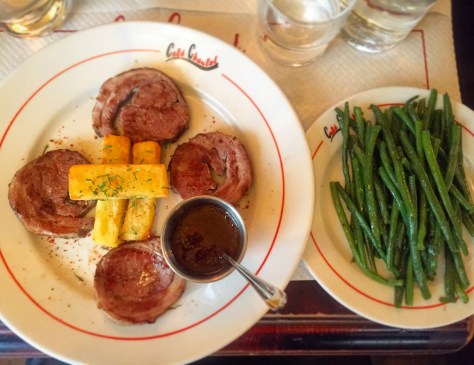
Everyone who knows me knows that my favorite café is Café Charlot on Rue de Bretagne. When it first opened, it bothered me that it was a bit more expensive than the other cafés in my neighborhood. After ignoring it for a long time, I finally gave in to its popularity, and walked in. I discovered it was way more than a café. It’s a way of life. Let me explain.
Café Charlot is owned by a restaurateur that has other cafés around town (La Favorite, Le St. Regis, for example), and like their other cafés, it looks like a New York idea of a French café, a sort of stylized retro: walls in white Métro tiles, dark wood tables and chairs, the zinc top bar, ceiling fans, indirect lighting — a sophisticated urban feel without being too stuffy.
The café
also behaves more like a New York restaurant than a Parisian café because the
menu and approach to service is more international in style, as is the
clientele. The wait staff speaks English, if not a variety of other languages,
and they don’t treat you as if they are doing you a favor to wait on you. If
you ask for slight changes to your order, they don’t balk; they just ask the
chef if it’s possible. I’m the queen of making changes to the dish in order to
satisfy my strict diet, and the chef happily goes above and beyond my request
to make me not just happy, but elated. In fact, he knows I love his cooking and
often rewards me with an extra special something, like a small bowl of the soupe du jour.
The quality of the food at Café Charlot is way beyond any other typical café I’ve ever known, and I’d put its chef up against the best bistro in the neighborhood. There is almost always at least one plat du jour apart from the usual menu, so I can have lunch there every single day and never get bored. My favorite over the years might be their lamb chops which, when they have them, are lean, tender, juicy, and ridiculously delicious. When they do beef, they do beef! You’ll get a big thick slab cooked to perfection and to go with it, you won’t want to miss their thin, crispy French fries—les frites. If you like salads, you absolutely must try their salade d’haricots verts, a mountain of crispy fresh-cooked green beans topped with a copious amount of pine nuts. The burgers are tall—beautiful totem poles of delight, impossible to eat with your hands (although I once sat next to the actor Jean Dujardin who did just that!). But, I almost never order off the menu when I can have their plat du jour. (I recently learned that my nickname among the wait staff is “Madame Plat du Jour.”)
Café Charlot is the café of choice of many of the fashionistas who invade the neighborhood during Fashion Week. Celebrities abound, not to be “seen,” but to be circumspect. There is every sort of Parisian, part-time Parisian, and even tourists who have heard about the café, but it still feels local because everyone seems so comfortable and at home in this casual place.
I’m truly a regular at Café Charlot and take the same table whenever possible. It’s the second from the left against the back wall. From that vantage point I can see all the goings-on, of which there are plenty. People know they might find me in my usual spot, and often stop in to say hello. And after so many years of coming here, the waiters know me and treat me with tremendous care, which I love, naturally. On top of it all, the WiFi works, and what could be more perfect than its location just a block away from home? I am truly grateful for Café Charlot. It’s my office-away-from-the office and it’s become my way of life. So I pay a bit more, but it sure is worth it!
ADRIAN LEEDS is a French property expert and HGTV personality. She has created a variety of businesses devoted to assisting other expats in their quest to fulfill their dream of living in France. Her company, the Adrian Leeds Group, is a licensed real estate agency offering complete property consultation services primarily for North Americans wanting to live and/or invest in France. Discover her site Attend one of her Après-Midi Events Facebook | Instagram | Twitter
SIGN UP FOR OUR NEWSLETTER and get the latest articles, news, and more. (Sign-up in the left-hand menu bar on desktop, or at the bottom of the page on mobile.)
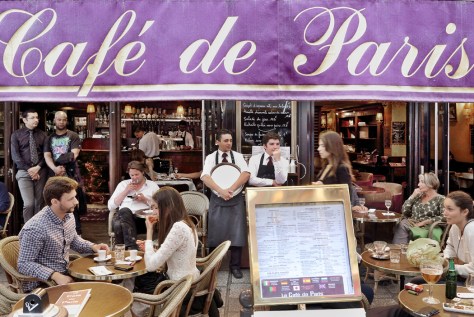
Every picture tells a story. In this case, half a dozen. Or maybe just the one: a young woman walking across the frame, and her many admirers. Ah, Paris. Captured at Café de Paris, before its makeover.
Want to submit a photo for our weekly column, Café Photo of the Week? Click here for submission rules. If we like it, we’ll publish it with a photo credit! Submission does not guarantee publication. Accepted photos will run in the order they are received. When you submit a photo, you give Save the Paris Café non-exclusive rights to publish it, free of charge, on our website and in social media, in perpetuity.
SIGN UP FOR OUR NEWSLETTER and get the latest articles, news, and more. (Sign-up in the left-hand menu bar on desktop, or at the bottom of the page on mobile.)
By Janice MacLeod, excerpted from her book, A Paris Year, page 109, “May 30: Café Saint Médard”
People don’t always take each other’s phone numbers in Paris. They just keep going to the same café at the same time as the same people. Old-school style. They could have friendships that span years without ever knowing each other’s phone number or even last name.
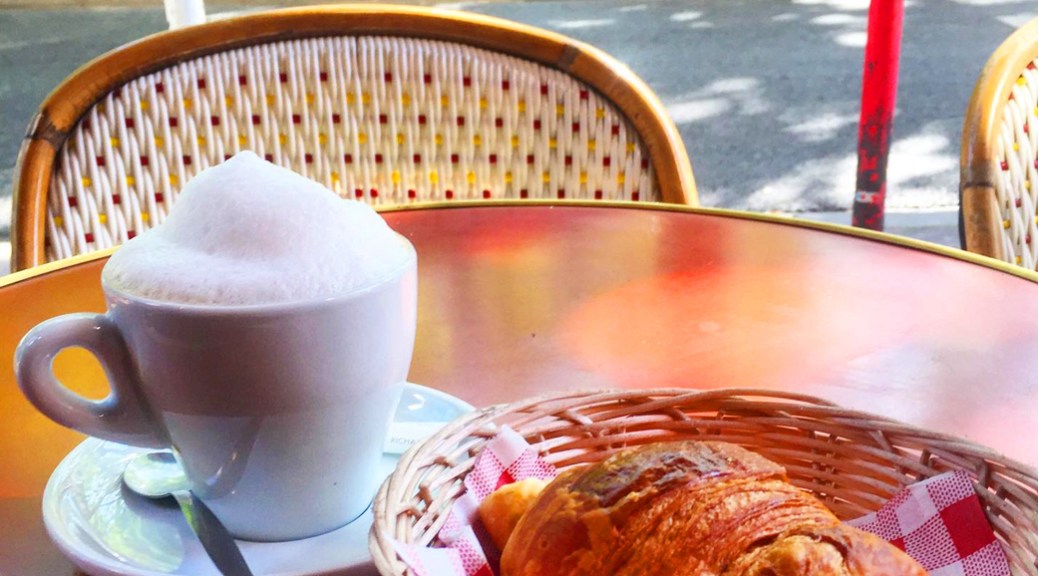
As for me, I arrived very early to get in a good writing session. My waiter hands me my café crème and we both get down to the writing for the day.
JANICE MacLEOD is the illustrator and author of the New York Times best-selling book Paris Letters, and her latest book, A Paris Year, part memoir / part visual journey through the streets of Paris. Discover her world at janicemacleod.com Visit her Etsy shop Like her Facebook page
Want to submit a photo for our weekly column, Café Photo of the Week? Click here for submission rules. If we like it, we’ll publish it with a photo credit! Submission does not guarantee publication. Accepted photos will run in the order they are received. When you submit a photo, you give Save the Paris Café non-exclusive rights to publish it, free of charge, on our website and in social media, in perpetuity.
SIGN UP FOR OUR NEWSLETTER and get the latest articles, news, and more. (Sign-up in the left-hand menu bar on desktop, or at the bottom of the page on mobile.)
[Trouvez ci-dessous la version française] A La Place Saint-George has something very hard to find in most other Paris cafés these days: sugar cubes. France, along with Belgium, is one of the few countries in the world where you can find sugar cubes. This café also has an incredible view of the romantic Place Saint-Georges, which is fitting because you are in the district of the 19th-Century Romantics.
The painter Eugéne Delacroix once had his art studio around the corner, and a passionate, young Victor Hugo wrote his poetry not far away. The renown female writer George Sand (George, like the square but without the S) used to organize terrific pot-luck parties nearby with her chéri, musician Frederic Chopin. Of course, the two lovers never forgot to invite their neighbor Honoré de Balzac.
While you’re stirring your spoon in your coffee to dissolve that sugar cube, you’ll be able to admire, just in front of you, the elegant private mansion of the marquise de Paiva, the famous courtesan. A man would pay one hundred times the price of your coffee to spend just half an hour with her. You’ll spend that same half hour in this cafe, contemplating the flamboyant artists and poets who used to live in this district—their voices whispering to you. And overcome with inspiration, you’ll compose a poem on the back of your bill, a passionate verse in the style of Alfred de Musset, tragic Romantic poet. Don’t forget to keep the bill. —Edith de Belleville
What to drink? Coffee: 2.40 euros, hot chocolate: 4.60 euros
What to eat? Planches de charcuterie or fromage d’Auvergne to share, from 18 euros
Credit card minimum: 10 euros
Don’t miss Edith’s cafe recommendations. Sign up for our newsletter on the sidebar menu on the homepage.
EDITH DE BELLEVILLE is a licensed tour guide in Paris, and the author of Belles et Rebelles, à l’ombre des Grandes Parisiennes (Éditions Erick Bonnier) available in French at Fnac.fr, Amazon.fr and Amazon.ca
Le café A la place Saint-George a quelque chose que l’on trouve de moins en moins dans les cafés à Paris: du sucre en morceaux. La France est avec la Belgique un des seuls pays au monde où l’on trouve du sucre en morceaux.
Ce café a aussi une vue imprenable sur la romantique place Saint-Georges car vous êtes dans le quartier des Romantiques du 19ème siècle. Le ténébreux peintre Eugène Delacroix avait son atelier au coin de la rue et le jeune et passionné Victor Hugo écrivait ses poèmes pas loin. La scandaleuse écrivaine George Sand (George comme la place mais sans la lettre s) organisait des fêtes d’enfer juste à côté avec son cher et tendre musicien Frederic Chopin. Bien sûr les deux amoureux n’oubliaient jamais d’inviter leur ami et voisin Honoré de Balzac.
Pendant que vous tournerez votre cuillère dans votre café afin de dissoudre votre sucre en morceau, vous pourrez aussi admirer juste en face de vous l’élégant hôtel particulier de la marquise de Paiva la célèbre courtisane. Alors vous penserez que les temps ont bien changé. Quel homme aujourd’hui se sentirait privilégié de payer cent fois le prix de votre café juste pour passer une demi-heure avec une femme ? Une demi-heure c’est exactement le temps qu’il vous faut pour vous rendre sur les traces de ces artistes flamboyants qui vécurent dans cet endroit poétique. Les voix de fantômes littéraires venus d’un passé onirique vous murmureront des vers délicieux. Alors, attablé au café de la place Saint-Georges et soudainement mû par une violente inspiration, vous composerez au dos de l’addition un poème que vous déclamerez avec flamme à votre dulcinée imitant le poète maudit et romantique Alfred de Musset. N’oubliez pas de conserver l’addition. —Edith de Belleville
Où ? 60 rue Saint-Georges, tel: 01.42.80.39.32
Quand ? Monday-Saturday, 8am-midnight; Sunday 8am-6pm
Comment y aller ? Métro Saint-Georges, line 12
Que boire ? Coffee 2.40 euros, hot chocolate 4.60 euros
Que manger ? Planches de charcuterie d’Auvergne à partager ; Planche de fromages d’Auvergne entre 18 et 19 euros Carte bleue minimum 10 euros
Guide-conférencière à Paris, EDITH DE BELLEVILLE est également l’auteure de Belles et Rebelles, à l’ombre des Grandes Parisiennes ( Éditions Erick Bonnier ) un livre disponible à la Fnac.fr, Amazon.fr et Amazon.ca
Rester au courant avec Edith et ses cafés preferés ! Abonnez-vous à notre newsletter, ici.
The lunch service at Ma Bourgogne, a lovely café situated on the Place des Vosges, which boasts historic painted ceilings and an enviable terrace. Captured by reader and photographer, Virginia Jones.
Want to submit a photo for our weekly column, Café Photo of the Week? Click here for submission rules. If we like it, we’ll publish it with a photo credit! Submission does not guarantee publication. Accepted photos will run in the order they are received. When you submit a photo, you give Save the Paris Café non-exclusive rights to publish it, free of charge, on our website and in social media, in perpetuity.
SIGN UP FOR OUR NEWSLETTER and get the latest articles, news, and more. (Sign-up in the left-hand menu bar on desktop, or at the bottom of the page on mobile.)
If someone were to say “Paris café style” to you, it would probably conjure up some immediate images: bentwood chairs, globe lights, wood paneling, maybe even a zinc bar. There’s a classic look to a café. A tad cliché, maybe, but it has stood the test of time, and somehow never looks dated, much like the American diner.
But even Paris cafés go through a relooking—makeover—every decade or so. Usually the changes stay somewhat within the vernacular: a new awning, a redux of their rattan Maison Gatti chairs, signage redesign. Mostly, it’s a much-needed refresh, yet it still feels Parisian: stylish, but not too trendy.
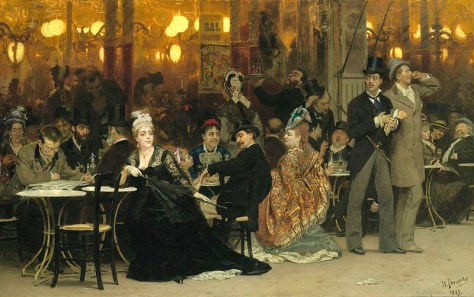
A Belle Epoque café captured by Ilya Repin in 1875. Wikimedia Commons
THE NEW DESIGN MOTTO: CONFORM OR PERISH
But these days design decision are more likely to be crowd-sourced by those with the power to “like.” It’s not about creating a unique look based on your brand identity; it’s about fitting in. With cafés struggling to stay in business, they’re not just renovating, they are actually duplicating each other in a scramble to stay on the map. If one changes their red awning to blue, so does the next one down the street. Aided and inspired by social media, trends sweep the city from quartier to quartier like a contagion, stamping out the authentic and replacing it with the Instagrammable.
“Tropical Chic.” One of the hot trends on Pinterest right now that’s sweeping Paris cafés. Courtesy of Pinterest.
If you’re trying to attract customers, put that money into a good chef and better coffee, and keep the café as is.
Sure, you can argue that there’s a sameness to classic café style, but at least it’s timeless and uniquely Parisian, instead of this soulless caricature of Brooklyn that’s (super)imposing itself on the city. Everyone is conforming to the exact trends, churning them out with zero interpretation: the same industrial furniture, the same cold color palate, the same minimalist feel—like hipster McDonalds franchises—so the look is already played out, even before the paint is dry on that relooking.
GOOD DESIGN IS ETERNAL; BAD DESIGN IS FORGETTABLE
No one is saying modern is bad. We’re talking about bad choices. When you design anything based solely on the trend of the day, you risk a result that might not resonate longterm. It’s just bad business. Cafés spend a lot to renovate—money they can ill afford in this economy—and it’s heartbreaking when they choose styles that will look dated in a year, especially after they’ve gutted their original 100-year-old interior to do it, one that still looked perfectly on brand, and would have for years to come.
Designer Matthew Waldman is famous for saying “the future should not look like the past.” You could add that it also shouldn’t look like the fleeting moment. If you must modernize, think about how your makeover design will look in five years’ time. If it won’t hold up like your current interior, scrap your plan. At the end of the day, if you’re trying to attract customers, put that same money into a good chef and better coffee, and keep the café as is.
Behold, the top 5 trends in café deco that we’re over already:
1: THE NAKED EDISON BULB
An obligatory element in any café makeover. A cool look…5 years ago. It’s a café, not a lab in Menlo Park, New Jersey. Put a lampshade on that thing; you’re burning our retinas.
And speaking of lampshades…
2: THE GIANT WICKER LAMPSHADE
The first time we saw this it seemed sort of design-y, but after the 50th café, Paris is starting to look more like a cheap beach resort. Baskets are for bread.
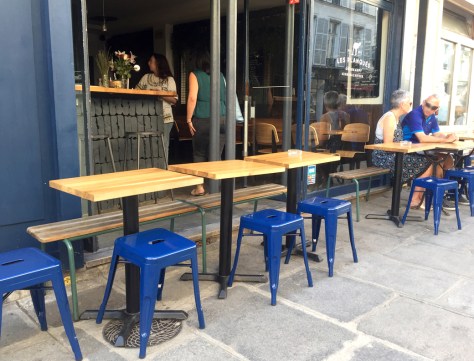
3: THE METAL STOOL
About as comfortable as sitting on a barbed wire fence, mais non? We’re assuming you don’t want us stay long. Even more fun for your fanny after that thing has been baking in the hot sun all day. Youch!
4: THE TINY TERRACE TABLE
Oh, sweetie, no. Do you really expect two people to eat at this flimsy little thing? There are limits to how far to take a trend. You might have reached it.
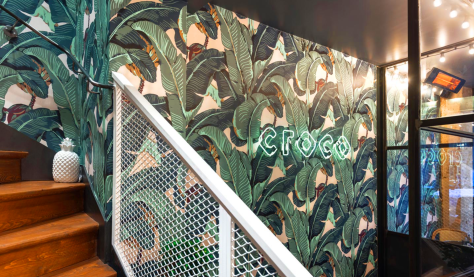
5: THE TROPICAL WALLPAPER
Giant palm fronds, pink flamingos—it’s so oddly specific, and so woefully out of place. Yet there it is, hopping from café to café, like a conga line. Even my local has gone Copa Cabana bananas.
My local. With basket lampshades for the full Tropicana effect. Babalu aye!
Top photo: Courtesy of Croco, formerly Café Cassis. Ironically, the idea for Save the Paris Café was born in the defuct Cassis. Croco is an entirely tropical-themed café…except for the food (though it’s pretty decent). But go figure.
Is anyone doing these trends right? Check out Mon Coco, at 6 Place de la Republique. The decor is more thoughtfully done: classic bentwood chairs are paired with the “Brooklyn-style” industrial table; a whimsical straw chandelier (instead of the ubiquitous basket lamp) hangs over a plush blue velvet booth; instead of tropical wallpaper, a mural by a street artist nods to the area’s gritty vibe. It makes a unique statement because it’s an extension of who they are, vs. what’s trendy, so it has a far better chance of holding up as time goes by.
Which Paris café has your favorite interior design? Let us know!
SIGN UP FOR OUR NEWSLETTER and get the latest articles, news, and more. (Sign-up in the left-hand menu bar on desktop, or at the bottom of the page on mobile.)





























 SAVE THE PARIS CAFÉ